The Eureka Stockade

|
The Eureka rebellion, which is often referred to as the 'Eureka Stockade', is a key event in the development of Australian democracy and Australian identity.
The rebellion came about because the goldfield workers (known as 'diggers') opposed the government miners' licences. The licences were a simple way for the government to tax the diggers. Licence fees had to be paid regardless of whether a digger's claim resulted in any gold. Less successful diggers found it difficult to pay their licence fees. (Source: http://www.australia.gov.au/) Click on the image to watch a video on The Eureka Stockade from the ABCs BTN program. |

Consider the significance of the 1854 Eureka Stockade in the development of Australian democracy. Investigate the social, political and economic impact of the gold rush on the colony of Victoria and examine the way migrants have shaped, and continue to shape, Australia’s traditions and identity. 
|
Life on the Gold Fields1854 – the year of the rebellionThe Eureka Stockage
Click to listen to Peter Lalor's famous 'Bakery Hill' speech
|
At the beginning of the 1850s, there was growing unrest among the miners. The government imposed a 30 shillings per month licence fee in order for the miners to work their claim. Police were sent to the goldfields to enforce the payment and were known to use unwarranted force when dealing with miners who did not, or could not, pay. In 1851, miners at Bendigo in Victoria held a large protest rally that began a movement for political change. The miners set about petitioning the government to revoke the licence fee.
In 1854 there were about 25,000 diggers of many nationalities on the Ballarat goldfields. More than half of these were British immigrants, and 40,000 were Chinese. There were also Americans, French, Italian, German, Polish and Hungarian exiles as well as many other nationalities. Aboriginal people were also present in many capacities: as Native Police, guides, wives and gold diggers, as well as trading cultural items and food. Women on the gold fields were assisted by Caroline Chisholm. (Source: http://www.australia.gov.au/) Governor Hotham came to power in June 1854 and set up licence checks twice a week to enforce the licensing laws. Tensions began to boil over as opposition to the licences increased. Official corruption was another concern for the diggers. This issue came to a head after a group of men beat to death a drunken Scottish digger, James Scobie. The group included local publican James Bentley. Bentley was a friend of the local magistrate and he escaped prosecution, as did three other men from the group.
This led to the diggers meeting on 17 October to try to bring the men to justice. After the meeting a crowd of diggers burnt Bentley's hotel to the ground. Soon after three diggers were arrested and charged with arson for their part in setting fire to the hotel. On 11 November, 10,000 diggers met to demand the release of the three diggers, the abolition of the licence and the vote for all males. The outcome of this meeting was the forming of the Ballarat Reform League. This was followed by an even larger meeting on 29 November where the diggers decided to publicly burn their mining licences. At this meeting the famous Southern Cross flag, which was to become known as the Eureka Flag, was displayed. In response to the meeting, the Gold Commissioner ordered a licence hunt for the following day. (Source: http://www.australia.gov.au/) On 30 November, 500 miners gathered under the Eureka flag (see below) and elected Peter Lalor (see below) as their leader. They swore to fight together against police and military. After the oath, they built a stockade at Eureka, and waited for the main attack.
On 3 December, there was an all-out clash between the miners and the police, supported by the military. The miners planned their defence and attack carefully, but they were no match for the well-armed force they faced. When the battle was over, 125 miners were taken prisoner and many were badly wounded. Six of the police and troopers were killed and there were at least 22 deaths among the diggers. The rebellion at the Eureka Stockade took terrible casualties, but although the miners were defeated on the day, they were successful in bringing about the changes they sought. Within months all the miners held for trial were acquitted, except one. A royal commission investigating the goldfields recommended that the licensing laws be replaced with a system whereby miners paid a tax on gold they found, instead of paying for the possibility of striking gold. Miners were also given the right to own the land on which they worked. (Source: http://ergo.slv.vic.gov.au/) |

Ballarat Goldfields

An actual miner's licence from 1854
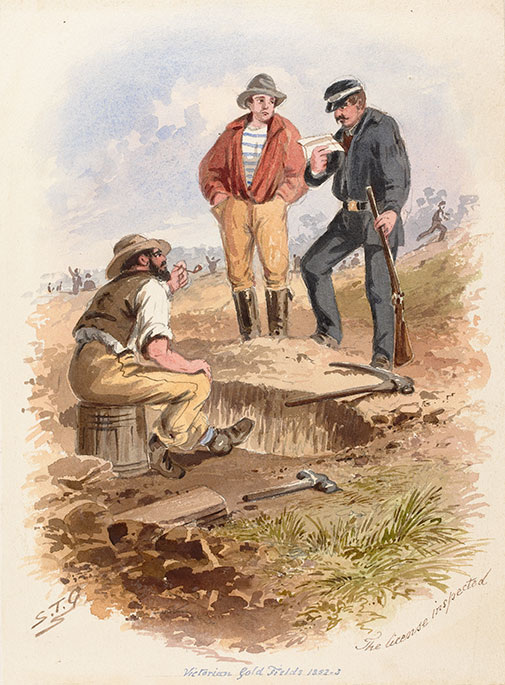
Miner's licence inspection


This pistol was used by Peter Lalor
|
Timeline of Events for the Eureka Stockade

Riot or Revolution (2005 documentary)
A partly dramatised documentary about the Eureka Stockade in colonial Victoria. The civil revolt was triggered by the government’s imposition of a gold licence for gold miners. The documentary consists of photographs and drawings of the event, some dramatic recreations, imaginative use of sound effects, and statements from experts like Thomas Keneally, Professor Geoffrey Blainey and historians, Weston Bate and Dr Anne Beggs Sunter. (Source: http://aso.gov.au/)
Click on each of the images to watch the clip
Click on each of the images to watch the clip

Clip 1
|
Clip description
In Victoria in the 1850s the introduction of a gold license was extremely unpopular. Although many diggers wanted it abolished immediately, the question of the license could not be separated from more complex questions about government revenue and taxation policy. The new Governor, Charles Hotham, was planning to review and reform these areas but he needed time and time was running out. He also felt strongly that existing laws, however unpopular, needed to be strongly enforced. |

Clip 2
|
Clip description
Drawings and archival photographs depict the events that lead to the battle between gold miners and authorities at the Eureka Stockade. It describes the emergence of Peter Lalor as the leader of the Stockade and how the diggers used the Southern Cross flag. |

Clip 3
|
Clip description
The Eureka Stockade was an armed rebellion against the gold miners’ tax imposed by the Victorian Government. It culminated in a fierce but brief (20-minute) battle in which 22 diggers and 5 troops were killed. Peter Lalor (Andrew Larkins) led the revolt. The battle is described through drawings, photographs, and dramatic re-enactment. |
Ballarat Reform LeagueThe Ballarat Reform League was formed on 11 November 1854 at Ballarat as a protest against the regulation of the gold diggings, specifically the League was formed with the view of abolishing the Miner's Licence and having the miners connected with the fire at the Eureka Hotel released.
Some of the demands of the Ballarat Reform League wanted:
|
What is a Stockade?
A rough barricade, enclosing about an acre of ground, on the Eureka lead. It was made as Lalor's headquarters. The barricade was flimsy and constructed of slabs stuck on end, brush wood, and whatever could be obtained handy. It enclosed several tents, stores, and windlass claims. It had been designed to conceal the operations of the head quarters staff rather than as a fort.
|

|

|
Significant People Involved in the Events of the Eureka Stockade


Statue of Peter Lalor at Eureka Centre, Ballarat
|
Peter LalorPeter Lalor was an Irish migrant who led the rebellion of the Eureka Stockade. In his early days he was relatively disinterested in politics, but the Eureka rebellion sparked a passion for justice that began his political career.
Lalor became upset over the murder of James Scobie and joined the Ballarat Reform League. At an assembly of miners on 30 November 1854, following a ‘digger hunt’, he became a somewhat accidental leader of the diggers. In the absence of the Reform League’s regular spokesmen, Lalor ‘mounted the stump and proclaimed “Liberty”, and called on the men to arm themselves and to organize for self-defence’. Some hundreds were enrolled and Lalor, according to Raffaello Carboni, 'knelt down, the head uncovered, and with the right hand pointing to the standard, exclaimed in a firm measured tone: “We swear by the Southern Cross to stand truly by each other to defend our rights and liberties”. Lalor stood his ground during the attack on the Eureka Stockade, and was wounded. He was smuggled off the battlefield to a party of doctors by whom his left arm was amputated at the shoulder. Despite a £200 reward being offered by Governor Hotham for information leading to Lalor’s arrest for treason and sedition, he managed to remain in hiding in Ballarat and later in Geelong. Following Eureka, an inquiry made a recommendation that the Legislative Council be enlarged to include elected representatives of the goldfields: Lalor was one of two diggers' leaders elected in November 1855 to represent Ballarat. Lalor enjoyed a long Parliamentary career, culminating in his appointment as Speaker in 1880.Following Eureka, an inquiry made a recommendation that the Legislative Council be enlarged to include elected representatives of the goldfields: Lalor was one of two diggers' leaders elected in November 1855 to represent Ballarat. Lalor enjoyed a long Parliamentary career, culminating in his appointment as Speaker in 1880. |

|
James ScobieJames Scobie (29 November 1826 – 7 October 1854) was a Scottish gold digger murdered at Ballarat, Victoria, Australia. His death was associated with a sequence of events which led to the Eureka Rebellion.
James Scobie was murdered on 7 October 1854 near the Eureka hotel. Scobie had tried to force his way into the hotel after hours for a drink and died in the ensuing confrontation. The inquest, which was privately and hastily held on the same day, cleared three men – including James Bentley, owner of the hotel and an ex-convict from Van Diemen’s Land - of any wrongdoing, much to the outrage of the diggers. A subsequent (another) judicial inquiry on 12 October, set up to quell (stop) the miners’ dissatisfaction with the verdict, also cleared Bentley. The future stockade leader Peter Lalor was involved in organising diggers to protest against the handling of investigations into Scobie’s death, including setting up a committee to further investigate the proceedings of the inquest and a petition to Lieutenant Governor Sir Charles Hotham. The controversy surrounding Scobie’s death came to a head on 17 October, when a crowd of five to ten thousand diggers assembled outside the Eureka hotel in protest and a riot eventually ensued which led to the destruction of the hotel. These actions caused more frequent license inspections. (Source: http://www.egold.net.au/) |
James BentleyJames Bentley was born in 1818 at Surrey, England. He arrived in Australia after being transported to Tasmania where he served a 10 year sentence, before being released in 1851. He migrated to Melbourne immediately after his release, where he worked as a confectioner and gold buyer in Melbourne. Eventually the lure of gold overcame him and he headed for the goldfields.
In Ballarat he was known as the builder and owner of Eureka Hotel, notorious for harbouring unsavoury types. The hotel opened on July 1854. On 18 November 1854, James Bentley, Thomas Farrell and William Hance were convicted of the manslaughter of James Scobie, a Scottish miner who had been found dead near James Bentley’s Eureka Hotel on 7 October 1854. Bentley, and his employees Farrell and Hance, had been tried and acquitted previously for this murder, but due to the outcry on the Ballarat Diggings, the insinuation of police corruption, and the subsequent riot and burning of the Eureka Hotel on 17 October 1854, there had been cause for a new trial. |

Eureka Hotel, owned by James Bentley, set alight due to rioting
|

|
Sir Charles HothamSir Charles Hotham, (14 January 1806 – 31 December 1855) was Lieutenant-Governor and, later, Governor of Victoria, Australia from 22 June 1854 to 10 November 1855. Hotham was governor at the time of the Eureka Stockade. When Hotham became lieutenant-governor, replacing La Trobe, he enforced mining licensing laws.
Tours of the gold regions had given Hotham the impression of men finding more gold than they did. One of Hotham’s first actions was to order twice-weekly licence searches. Hotham's actions brought all the simmering grievances of the diggers to the fore again; license hunts, the incompetence and corruption of the police and the inadequate services provided by the government of the goldfields. Added to this was the growing poverty of the Ballarat diggers. Yields per man from alluvial (shallow) mining were declining, and only very small claims were allowed. Shafts had to go down to greater depths, requiring enormous physical effort for very little reward. (Source: Wikipedia, http://www.sbs.com.au/) |
The Eureka Flag
|
Since it fluttered above a group of rebellious gold miners at the 1854 Eureka Stockade, the flag of the Southern Cross has become a symbol of democracy and defiance. Now carefully preserved at the Art Gallery of Ballarat in Victoria, the flag, and the National Heritage-listed Eureka Stockade Gardens, remain potent symbols of Australia’s only revolution – a battle that was over in less than half an hour and claimed 38 lives. Whether the revolution is interpreted as the birth of Australian democracy or a middle-class tax revolt, it was without doubt a defining moment in Australia’s history.
(Source: http://www.nfsa.gov.au/) Click on the flag to the right to watch a video about the flag's importance. |

|
